




What Is a Meter Collar and How It Simplifies Solar & EV Installation

A meter collar is a small device that lets Southern California homeowners skip expensive electrical panel upgrades when installing solar panels, batteries, or EV chargers — saving thousands and cutting weeks off the timeline.
You've done the research. You're ready to go solar, add a battery, or install an EV charger. Then your installer delivers the news nobody wants to hear: "Your electrical panel can't handle it. You need a full upgrade first."
In Southern California, a standard 100-to-200-amp panel upgrade runs anywhere from $2,500 to $4,500 — sometimes more if trenching or underground wiring is involved. And it can delay your project by weeks. With rising electricity costs in Southern California already squeezing household budgets, that's a tough pill to swallow.
But there's a smarter alternative that most homeowners don't know about yet: the meter collar.
What Exactly Is a Meter Collar?
A Simple Device in a Critical Location
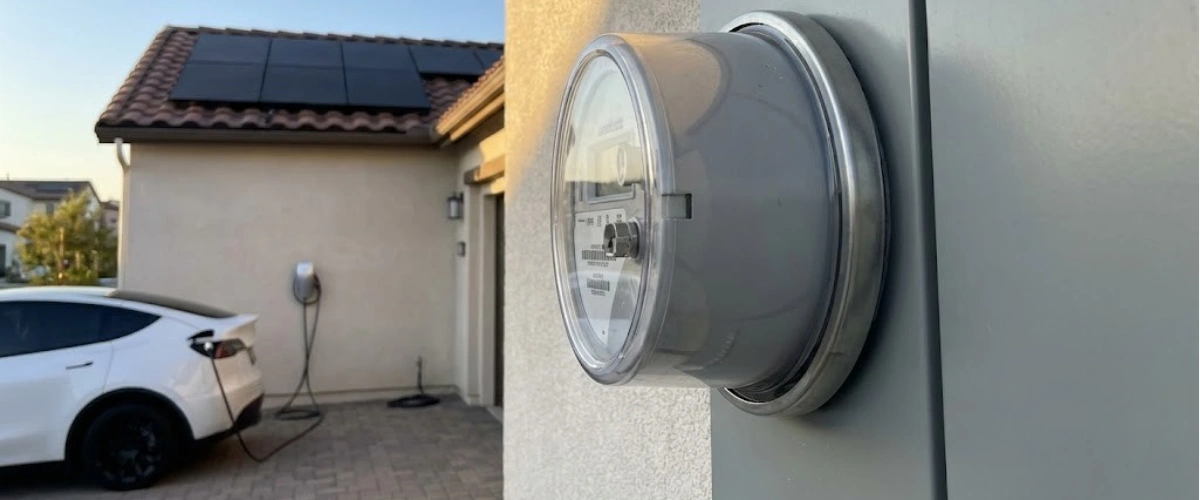
A meter collar — sometimes called a meter socket adapter — is a compact device that installs between your home's electric meter and the utility meter socket. Instead of routing new solar, battery, or EV circuits through your main electrical panel, the collar provides a dedicated connection point right at the meter.
Think of it this way: your electrical panel is like a crowded parking lot with no open spaces. A meter collar adds a new entrance to the lot — one that bypasses the congestion entirely. It lets you connect solar panels, a battery system, or an EV charger without touching your existing panel.
If you're curious about where solar panels connect to your home, a meter collar changes the answer. Instead of connecting through a breaker in your main panel, the system ties in at the meter itself — not behind it, not in front of it, but right at it.
What Can a Meter Collar Connect?
Meter collars support a range of clean energy technologies, including solar panel systems, battery storage units, Level 2 EV chargers, and backup generators. Some advanced collars — like Enphase's IQ Meter Collar — even function as microgrid interconnection devices, enabling whole-home backup without rewiring loads to a sub-panel.
Why Meter Collars Matter for Southern California Solar Installations
The Panel Upgrade Problem
Many Southern California homes — especially those built before 2000 — were designed with 100-amp or 150-amp electrical panels. Those panels weren't built for today's energy demands. Adding solar, a battery, or a 40-to-50-amp EV charger can push an older panel past its safe limits, triggering a mandatory upgrade.
That upgrade means hiring a licensed electrician, pulling permits, coordinating with SCE, and waiting weeks for inspections and approvals. For homeowners who are already dealing with SCE rates that climbed roughly 13% in late 2025 — with peak time-of-use rates now hitting 58 to 74 cents per kWh — every month of delay is money out of pocket.
How a Collar Eliminates the Bottleneck
A meter collar bypasses the panel entirely. Here's what that means for you as a homeowner:
No major electrical work. Your existing panel stays exactly as it is. No rewiring, no trenching, no wall demolition.
Thousands in savings. A meter collar typically costs a fraction of a full panel upgrade — saving homeowners 60 to 80% compared to a traditional 200-amp upgrade.
Hours instead of weeks. While a panel upgrade can take days of labor plus weeks of permitting, a meter collar can be installed in a matter of hours.
Code-compliant and utility-approved. SDG&E has formally approved meter collars, PG&E followed in early 2026, and SCE pilots are underway with full approval expected soon. Major manufacturers like Enphase, ConnectDER, and Tesla all produce collar products.
For a deeper comparison, check out our breakdown of panel upgrades vs meter collar options for older homes.
How Meter Collars Work with Battery Storage
Why NEM 3.0 Makes Batteries Essential
Under California's NEM 3.0 billing structure, the credits you earn for sending excess solar power back to the grid are worth far less than they were under NEM 2.0. That means storing your own energy — and using it during expensive peak hours — is now the key to maximizing solar savings.
A meter collar makes adding battery storage dramatically simpler. Advanced collars like the Enphase IQ Meter Collar integrate a microgrid interconnection device (MID) directly into the unit. That means your battery can provide whole-home backup during outages without requiring a separate backup sub-panel or hours of rewiring.
This is a major win for homeowners who want to learn how solar batteries maximize your savings under the new billing rules. And if you're weighing different options, our guide to choosing the right backup for your home walks through the key decisions.
A Streamlined System from Meter to Battery
The traditional approach to adding battery backup involved installing a dedicated sub-panel, moving critical circuits to that sub-panel, running new conduit, and adding separate metering hardware. A meter collar collapses much of that work into a single device — reducing wall clutter, installation time, and overall cost.
Meter Collars and EV Charging in Southern California
The EV Panel Problem
Electric vehicle adoption is accelerating across Los Angeles, Orange County, and the Inland Empire. But installing a Level 2 home charger typically requires 40 to 50 amps of available panel capacity — and many older SoCal homes simply don't have it.
Without a meter collar, you'd need a full panel upgrade just to plug in your car at home. With a collar, the EV charger connects directly at the meter, drawing power without overloading your existing panel. ConnectDER's EV adapter even monitors your main panel consumption in real time and adjusts charging speed automatically to stay within safe limits.
For homeowners planning both solar and EV charging, a meter collar creates a single, future-proof solution. Our EV charger guide for SoCal homeowners covers everything from charger types to installation costs.
What US Power Does Differently
Holistic Electrical Assessment
At US Power, we don't just sell solar panels. Our CSLB-licensed consultants evaluate your home's entire electrical system — panel capacity, meter configuration, roof layout, and energy usage patterns — before recommending a solution.
If a meter collar is the right fit, we'll tell you. If a targeted panel upgrade makes more sense for your situation, we'll explain why. We're not locked into one approach. We're locked into finding the approach that saves you the most money and gets you to permission to operate (PTO) fastest.
Factory-Direct QCells and Faster Timelines
As an exclusive QCells partner with factory-direct pricing, US Power delivers American-made panels at 15–20% below typical market rates. Combined with a meter collar installation, our solar installation timeline is one of the fastest in the region — typically 3 to 4 weeks from approval to PTO.
Every project includes a 25-year comprehensive warranty covering panels, workmanship, and performance. And with 180+ five-star Google reviews, our track record speaks for itself.
Is a Meter Collar Right for Your Home?
When a Collar Makes Sense
A meter collar is likely a good fit if your home has a 100-amp or 150-amp panel that can't accommodate new circuits, you want to add solar, a battery, or an EV charger without a full panel replacement, your home uses a combination meter/main panel (common across Southern California), or you want to minimize installation cost and project delays.
When You Might Still Need a Panel Upgrade
A meter collar isn't a universal solution. If your panel is severely outdated (with Federal Pacific or Zinsco breakers, for example), has safety issues, or needs significant rewiring for other reasons, a full upgrade may be the better path. Your installer should evaluate the full picture — which is exactly what US Power does during every free consultation.
To make sure your system is properly designed regardless of the path you choose, it helps to size your solar system correctly from the start.
Make Clean Energy Simpler with the Right Technology
A meter collar is one of the most practical innovations in residential solar and EV installation today. For Southern California homeowners stuck between rising SCE bills and the prospect of an expensive panel upgrade, it offers a faster, cheaper, and fully code-compliant alternative.
The key is working with an installer who evaluates your home honestly and recommends the right solution — not just the one that generates the biggest invoice.
Frequently Asked Questions
How much does a meter collar cost compared to a panel upgrade?
Are meter collars approved by SCE?
Can I use a meter collar for both solar and an EV charger?
Is a meter collar as safe as a traditional panel upgrade?
How long does it take to install a meter collar?



A Southern California Homeowner's Guide to Avoiding Overpaying
Getting solar quotes that differ by thousands of dollars? You're not alone.
kW vs. kWh: Comparing Watts to Kilowatts and Kilowatt-Hours
Understand how to track watts, kW, and kWh to save on electricity efficiently.
AC vs DC Power in Solar: A California Homeowner’s Guide
Understand AC vs DC power and how it drives reliable solar energy in California.








Copyright © 2025 US Power - Axia by QCells. All Rights Reserved.

Get an instant solar estimate using satellite!